Starting Point

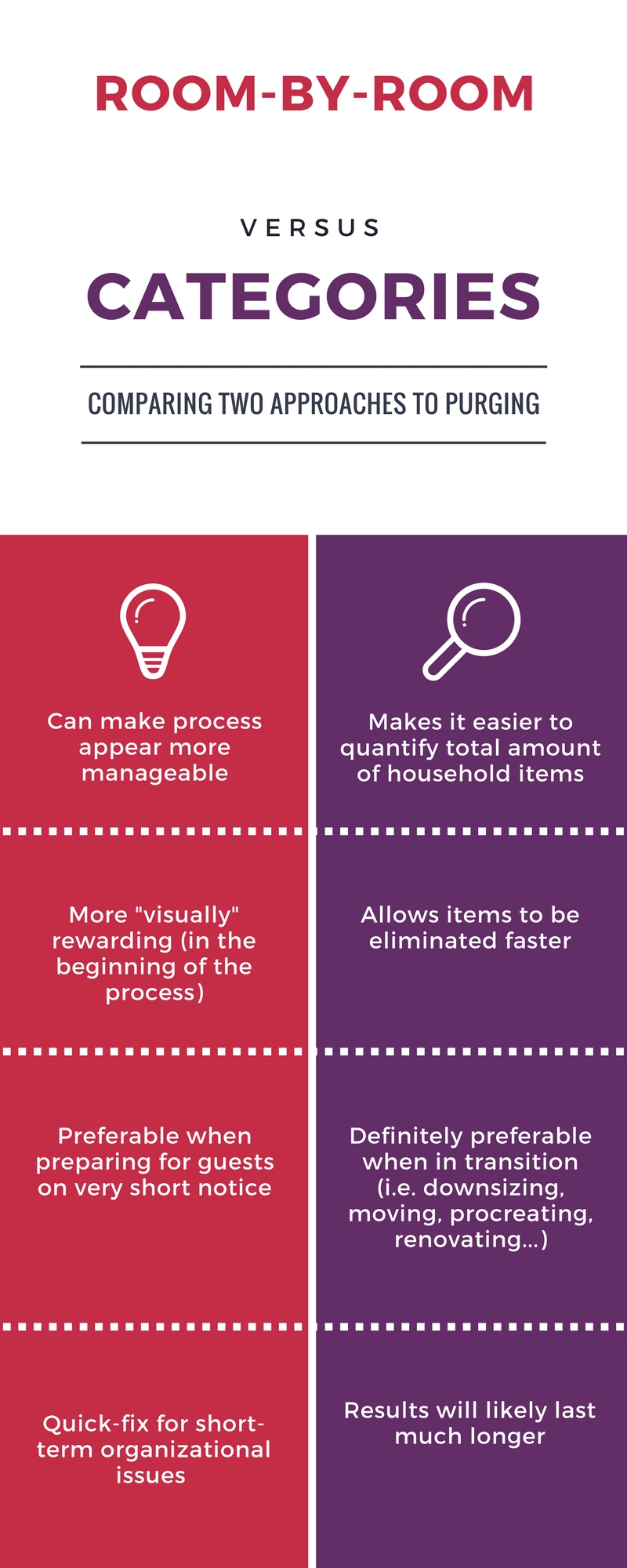
Probably the most common challenges people face after deciding to get organized is figuring out where to start. It is at this point that a person is likely taking in the view of the disorganization in its entirety and feeling overwhelmed. My number one secret to starting virtually any organizing project is actually quite simple: categorize, categorize, categorize.

The easiest way to begin categorizing a pile of “clutter” is to start by grouping “like with like.” If a closet requires more organization, gather all the shirts with shirts, pants with pants, belts with belts, etc. The basic act will bring clarity and allow the clothing to be further organized by season, fabric weight, color, casual vs. formal, or in any other way that will make the closet more visually appealing and accessible.

Organizing a “junk drawer” or items that may be stored on an exposed surface like the top of a dresser may seem more daunting. Nevertheless, the same principle applies. When grouping items in these types of situations, I highly recommend maintaining groups by using drawer dividers or small baskets/boxes/bins/drawer organizers that are of an appropriate size. A key advantage to creating and maintaining categories is by doing so, you will gain a better sense of which items can and should be readily purged.

By teaching yourself to quickly categorize the items in your living or work space, you will likely find that, after your first attempt at organizing, you will be required to spend less time maintaining your newly organized space. And when it is time to reorganize or purge, being able to assess items by category may also make the process seem less overwhelming.

Digging Out of the Aftermath of Depression

[Disclaimer: I am not a licensed counselor, social worker, psychiatrist, or psychologist. The following post is intended for motivational purposes only for individuals who would like to create a more organized environment. Individuals who believe they may be experiencing depression are urged to seek out a licensed counselor or other mental healthcare professional.]

I recently worked with a client who is an accomplished businesswoman. She is also at the tail end of a six month struggle with anxiety and depression. She described herself as “finally having the motivation to do something, but felt terrible after looking around” and seeing the state of her home. In particular, she had been avoiding her office area and another space that was dedicated to her love of working on craft projects.

Feeling overwhelmed when emerging from a period of physical illness or depression is not uncommon. Oftentimes, people struggle with finding a place to begin in restoring order to their environment. As illustrated in the example above, remaining in a disorganized home or work environment can lead to procrastination and additional feelings of guilt and anxiety, thus potentially creating a negative cycle that can become very difficult to break: eating habits may suffer, work performance declines, and a daily schedule that was once filled with more fulfilling activities may be reduced to simply going to bed upon arriving home or watching television until falling asleep.

In these situations, starting small and organizing one area at a time may be most effective. Those who have recently experienced anxiety, depression, or illness my require more immediate results. Small victories up front may provide the momentum these individuals need to keep going and to dramatically transform their environment. The following suggestions may help virtually anyone who is struggling with getting started on a large organizing project, especially those who are recovering from emotional or physical stress or illness.

  • Organize according to your energy level. I am a firm believer in realistically creating a plan before beginning an organizing project and tailoring the steps within the plan to your mental and physical energy level at the time. It is okay (and even encouraged!) to set relatively challenging targets, but plan to take a break or reach a stopping point before you would typically expect to become completely exhausted.
  • Start small. If you lack the time, energy, and focus to organize your entire home or office within a day or over the course of a weekend, divide the project into manageable parts. Can you organize one room at a time? If not, try starting with a single closet, dresser, or “junk drawer.”  Whether removing clutter from a bookshelf or donating old clothes from a closet, completing the first part of a large project often provides the inspiration to do more.
  • Don’t organize alone! Call a friend who will help you and keep you accountable, or call a professional organizer! An organizer can coach you along while offering the encouragement and, if necessary, healthy distraction from the more mundane or perhaps overwhelming parts of the process.

Contrary to what most people believe, there is no one-size-fits-all approach to getting organized. Therefore, the individual must consider his or her specific needs and goals when setting out to affect a lasting, positive change in his or her environment.


Photo by Pixabay on Pexels.com

What is Professional Organizing?

Simply stated, professional organizing is a process through which a system is put in place to help individuals and businesses become more orderly. It is one of many very effective ways to improve quality of life and boost productivity.

What is the Rolanda L. Method?

Disorganization is typically a symptom of a larger disruption in an individual’s life. Sometimes the cause of the disruption may be minor and temporary like moving to a new residence or redecorating. In other cases, disorganization may have a root cause that is very chronic and persistent. Regardless the cause of a disorganized home or office, Rolanda L, Professional Organizer seeks to address each individual situation at its origin and to design and implement solutions that will ultimately set the client up for continued success. The Rolanda L. Method is a holistic approach to organizing!

What Can Be Organized (…Professionally)?

Closets, cabinets, shelves, paperwork, filing systems, you name it! Rolanda L. is also available to assist with furniture selection, room layout, and color coordination. Our clients also love our specialized relocation packing service, which makes moving to a new home or office much more efficient and generally more secure. Having a highly detail-oriented professional organizer handle packing during a move makes the entire process much faster and easier from start to finish.

But I Always Seem to Find Myself Needing to Reorganize… 

Solution: Work with a professional organizer to implement a system and/or layout that works well with your lifestyle and behavioral habits…We happen to know one if you’re interested!

If you are unable to work with an organizer, simply take inventory of your daily routine (even if it is somewhat erratic), and ask yourself if you have designed your home and everything in it in a way that supports you in achieving your daily objectives. If the answer is no, walk through each aspect of an average day in your life, ask yourself what could be improved to increase efficiency and peace of mind. Then modify your environment accordingly. Keeping a journal of observations and changes may be helpful.

Also ask about our affordable workshop events, where you can learn organizing strategies in a supportive small group setting led by Rolanda!

Put me in touch with your pro.

Why certainly! Click here.


Choosing Achievement-Friendly Environments

This is a quick #ItsPersonal post.

An often overlooked step in goal-setting is creating surroundings that support the desired outcome. For most of us, the people with whom we spend time are the most critical part our “surroundings.” Therefore, many times, it’s not enough to simply set a goal and work at it in isolation. Losing weight may require joining a class or playing a sport in addition to working out alone. Making nutritional changes is much easier after taking a cooking class or attending healthy food-themed events. Learning a new skill is often more enjoyable when meeting with groups of people who share the same interest and are working toward a similar goal.

In addition to deliberately placing yourself in settings with like-minded people, it is also important to find others who know more than you and who are further along in their experience. Not only can a more accomplished person with similar interests tell you how they met their goals, but you can also examine their description of the road they’ve taken and decide whether it leads to where you’d like to be. #ItsPersonal

It’s very easy to become your surroundings. Therefore, achieving different results may require a change in scenery and a different cast of supporting characters. Moreover, we should always be mindful of our surrounding environment and the company we choose to keep. The human brain is constantly processing and responding to data from our surroundings–even when we don’t realize the outside influence.

Let’s Get Personal

It’s safe to say the overwhelming majority of people who meet me, especially in a work capacity, view me as a “solutions-oriented” personality. The minute a problem arises, I quickly begin the process of finding and evaluating the best possible solutions. It’s pretty automatic. Sometimes process starts well before a potential problem can arise. Nevertheless, I recognize I don’t have all the answers […at least not immediately?]. In fact, I’ve found that my willingness to be “human” and to share the fruits of my own [admittedly sometimes wacky] trial-and-error episodes brings an added level of comfort and relatability when working with clients. I was at a workshop for startup founders and entrepreneurs tonight when the obvious occurred to me: I should be bringing that level of humanness to my blog. And with that, I’d like to introduce the #ItsPersonal tag!

My journey as an entrepreneur is fertile ground for the very same lessons and principles I impart to my clients day in and day out, week after week. I’m a believer in teaching and encouraging by example. Tonight, in a lightning bolt-esque moment, it occurred to me that others may also be able to learn and grow by getting an inside look at my own exercise in diligently applying the life-changing concepts I’m always sharing with others.

Through my #ItsPersonal posts, I will aim to share more of my personal insights as a young business owner (along with other more personal stories that impact me as an entrepreneur and as a pro organizer). I hope my stories will leave readers feeling motivated, inspired, (and maaaybe a little entertainment…).

In closing, I will highlight a particular principle that especially rang true for me today and inspired this post (…and the #ItsPersonal posts that will follow): sometimes you just have to pick a starting point and GO!

I’ve probably coached hundreds of people in taking the initiative to “launch,” whether it was the beginning of an organizing project, researching a next move, pursuing a dream, going abroad, applying for schools… But very recently, I’ve been quietly struggling with having several business-related ideas and choosing which to pursue…and in what order. After narrowing the  list down to the most immediately feasible, I still found myself procrastinating and unnecessarily dragging out the regular tasks on my daily to-do lists–anything to avoid taking decisive action.  Today, I was reminded that there comes a point at which there is one thing left to do, and it’s to take the first step forward. After taking that step, however large or small, you can always step backward, continue along the same trajectory, or even go left or right. But once you’ve planned, deliberated, and identified a goal, there is one guarantee: the act of standing in place won’t bring you any closer to it… #ItsPersonal


How to Tame Your Junk Mail

Despite the tremendous technological advances mankind has achieved, most of us still have a steady stream of “junk mail” that enters our home. Junk mail is one of the most common obstacles that separates households from becoming organized. Some people allow their mail to accumulate on a desk or table that is typically located near the front door, where the mail makes its entrance. Others simply stash unwanted mail into a large bin or trash bag with the intent to sort and declutter by eventually shredding the excess paper.

The following suggestions will help you avoid the massive pileup that often results after weeks, months, and after especially years of an unaddressed influx of mail.

1. Go Paperless – Unless you require paper copies of bills and statements, paperless is the way to go. Virtually all financial institutions and utility providers offer–and even prefer–e-statements, which can be accessed online or received through email, depending on the issuer.

2. Create a System – Most homes need a system by which mail can be quickly and easily divided AS SOON AS IT ENTERS THE HOUSEHOLD. I recommend using a hanging mail sorter like the one below. One tray should be labeled “IMMEDIATE” for mail that requires immediate attention. The second tray should be labeled “NON-URGENT” for mail that requires action within the next several weeks or months (i.e. renewing a magazine subscription). I also highly recommend placing a basket or small bin labeled “RECYCLING” directly under the mail sorter.  This is where junk mail should go as soon as it enters the home.

Hanging mail sorter example (Amazon affiliate link):

3. Schedule time for upkeep – You will need to schedule time to address your junk mail organizational system. Otherwise it will overflow. I recommend setting aside an hour weekly to (1) address any lingering urgent mail, (2) move non-urgent items that are approaching their deadline to the urgent box, and (3) empty the recycling bin (and prepare it for curbside pickup if offered in your community). The weekly hour of mail decluttering can be scheduled concurrently with another activity, for example, if you are a person who enjoys watching television or listening to podcasts. It may also be easier to tackle a task like mail intake as an end-of-day cleanup activity before going to bed. Although I am recommending an hour, most households that address their mail weekly will likely need far less time to complete this task.

4. Deal with currently overflowing junk mail bags and bins – Many of us already have a stash of junk mail we “intended to go through and shred.” Over time, looking at that pile can become overwhelming. While the best approach is to simply go through and shred all the unwanted mail at once, many people may feel they simply do not have the energy. If this is the case, I would advise dividing the backlogged mail and setting goals (i.e. sorting and shredding 1/4 of the pile Monday, another 1/4 Friday, and so on until it’s gone). The important elements in this less intensive, “incremental” approach to decluttering mail are 1) setting clear goals and a realistic, but productive timeline and 2) being diligent in execution. If you set a productive timeline and stick to it, your pile of junk mail will be gone in seemingly no time, and your only related weekly task will be basic upkeep of your new system.

The key to both overcoming and avoiding junk mail clutter is to work at it strategically and consistently over time.


Entertain in Your Home Without Last-Minute”Cleaning Anxiety”

Most people can relate to making a mad dash around their home before people come over. But not only is this frantic routine avoidable in a properly organized home, it ultimately becomes completely unnecessary. Remaining ready for guest drop-ins is not always indicative of a need to clean more frequently, but it is often a matter that simply calls for more planning and deliberation when it comes to home organization.

Addressing the Issue at its Root Cause

It’s pretty easy to assume that the need to scramble to tidy before entertaining guests comes from simply not getting around to cleaning up. While this may be true in part, the underlying issue runs much deeper. A home in which every object has a designated resting place is less likely to require frantic cleaning. In the case of the person who says he or she struggles to put things back in place, I would even go one step further and say the problem lies in the fact that the current system of organization simply doesn’t suit the individual or household.

Working Smarter, Not Harder

I often encounter clients who say they tried purchasing various containers and organizing tools and read books on organizing, but still find themselves struggling with their spaces. Upon evaluating the client’s lifestyle and home, I typically observe glaring incompatibility in the way they are attempting to organize their home and their current needs and behavioral habits. The easiest way to combat this incompatibility is to spend a day observing your routine and arrange the home accordingly. For example, people who like to change immediately after work, but find that their clothes tend to accumulate on chairs and furniture should consider placing a clothes bin or hamper near the entrance of the bedroom, in the bathroom, or in close proximity to the furniture that seems to attract the discarded clothing.  Those who find that their bedroom requires more storage space for shoes, should consider keeping the shoes they wear most often on a rack in a common coat closet or on a shelf near the entry of the home. Sometimes departing from tradition can lead to a more functional approach that makes the task of keeping a home neat and guest-ready much easier.

The Bottom Line

Being more intentional in choosing storage containers and organizing tools–and even in planning room layout–can save time that would otherwise be spent gathering loose items and returning them to their rightful place. Therefore, it is okay to think about what “feels” right in terms of organizing as long as you achieve your ultimate end goals for your home and lifestyle.


What I’ve Been Working On

I’m always attempting to learn everything I can about better ways of organizing my own lifestyle as well as the lifestyles of my clients who ask me for help! The latest thought organizing, record keeping, planning, and projecting idea I am experimenting with is the famed Bullet Journal! Don’t know what it is? Take a look at the video here:

So far, my journal has shaped up to be very linear and filled with words versus graphics. Nevertheless, this style of keeping track of things is extremely adaptable. I am finding it to be more enjoyable than keeping a standard appointment book or calendar. Also important to note: I have two bullet journals, one for professional life and another for social. I am excited to see how my style of bullet journaling will evolve over the year. For now, the overall technique is a keeper!

Set Yourself Up for Success

It’s October. The leaves are crisp. The weather is soggy (here in New York). Pumpkin Spice Lattes are flowing freely. These are a few of our favorite things, right?

In addition to fall boots, sweaters, cool nights by the fire pit, and pumpkin-flavored everything, there is another gigantic advantage to the fall season we often overlook: we have just entered the quiet before the holiday frenzy. Therefore, this moment of relative quiet is  the perfect time to sit down and make clear, sober plans to set ourselves up for a prosperous New Year. It is an opportune time to position ourselves to make New Year’s resolutions we will actually keep.

What does this mean for our lives in general? Assess, assess, assess. If you struggle with your weight or bad health habits, sit down and think about how you can do things differently. Visit the doctor. Have your levels checked. Is your cholesterol a little high? Let’s make a plan now to anticipate cutting down on saturated fats and high cholesterol foods in the New Year (…right after we enjoy the rich, holiday foods). Start looking into gyms. Think about an athletic activity you enjoy or a fitness class you’d like to take. Do some research…Is money management your thing? Think about what a realistic budget for your household might entail in 2017.  Social anxiety got you down? Let’s start thinking about healthy ways we can meet people in the upcoming year. What hasn’t worked well for us in 2016? Anticipate. Plan. Begin the mental prep work now.

And finally…what does this mean in terms of getting organized? If you’re already my client, now is the perfect time to schedule a “check-up” to see how well your current strategies have been working. If you’re not my client, let’s get acquainted. Visit our Contact page, and schedule an appointment with me to talk about how we can make your home or work space feel more comfortable and run more smoothly. Once we embark on the journey of exploring the connection between your environment, your sense of well-being, and your overall productivity, I guarantee your outlook on the concept of “space” will never be the same. Let’s talk organization, and let’s get empowered!

Happy October!